
I’m a big fan of the long-running reality show Kitchen Nightmares. Each episode follows the same satisfying formula: Michelin-starred chef Gordon Ramsay visits a horribly struggling restaurant and within forty minutes, identifies its problems, confronts stubborn obstacles, and encourages solutions to put the wayward restaurant back on the path to success.
Being a reality series, there’s a fair bit of ginned-up drama, but the rehab pattern is consistent with my hope for this article series. Chef Ramsay typically advises trimming an over-complicated menu to focus on a core recipe the restaurant already knew how to make well. The wisdom: Baking the best slice of pizza in town is better for business than offering eighty mediocre dishes found everywhere.
In my previous article, I speculated that many children’s museums face existential challenges and the solution may be to tighten their focus on what they can do better than anywhere else. Like the Association of Children’s Museums, I believe in the power of play, but I think that power, above all other offerings, is to refuel our love for life and for each other. Children's museums are perfectly poised to be places where we all go, regardless of age, for connection through rejuvenating play.
What does it mean to plan a museum around intergenerational connection? Think about watching a classic Pixar movie (Toy Story, The Incredibles, Inside Out, etc.). People of all ages find encouragement to be fully present, emotionally vulnerable, and personally invested. Maybe, like me, you shed an adult tear during Up, while your bemused 4-year-old asked if you were alright. Great children’s museums, like great children’s books or movies, should, as author Mac Barnett declares, “tell the truth about what it means to be a human in the world.” (Mac Barnett, Make Believe: On Telling Stories to Children (New York: Little, Brown and Company, 2026), 10.). Our brains, younger and older, thrive on beauty, humor, fear, joy, sadness, struggle, surprise… and all the complexities that texture our lives. Why then do children’s museums settle for over-simplified cuteness and heavy-handed lessons?
This isn’t an article about how to design for intergenerational connection. That is a much longer conversation (and requires hiring people like us). Instead, this series asks two questions: Could connection through play be a children’s museum’s most vital, distinctive offering? And what are the organizational implications of making this a top priority?
Here are 3 potential strategic considerations:
1. Adding Adults to Your Museum’s Mission
Every great children’s museum should make it just a little easier to be a parent, grandparent, aunt, uncle, nanny, etc. Caregiver support should be part of every museum’s mission.
Exhibits, amenities, programs, and staff can be orchestrated to help caregivers say “yes” more than “no” and feel happier and healthier for having visited. Is ample, free parking available? Lockable storage? Great coffee and affordable snacks? Friendly, actively helpful staff? Clean bathrooms? Comfortable seating close to the action?
These questions of family accommodation, while important, are not the same as asking how adult caregivers could also be transformed by your museum experience.
In addition to accommodation, you should also consider engaging and rejuvenating experiences for caregivers and children. For this, we can look back at the Pixar analogy. Every memorable movie shares 3 things a great children’s museum should also strive to provide: Inhabit artfully composed worlds (WALL-E); go on an adventure (Finding Nemo); and find encouragement to feel LOTS of different emotions (all of them). Very few children’s museums intentionally establish these 3 vital “roots” and instead get lost in the “canopy” of exhibit content types.
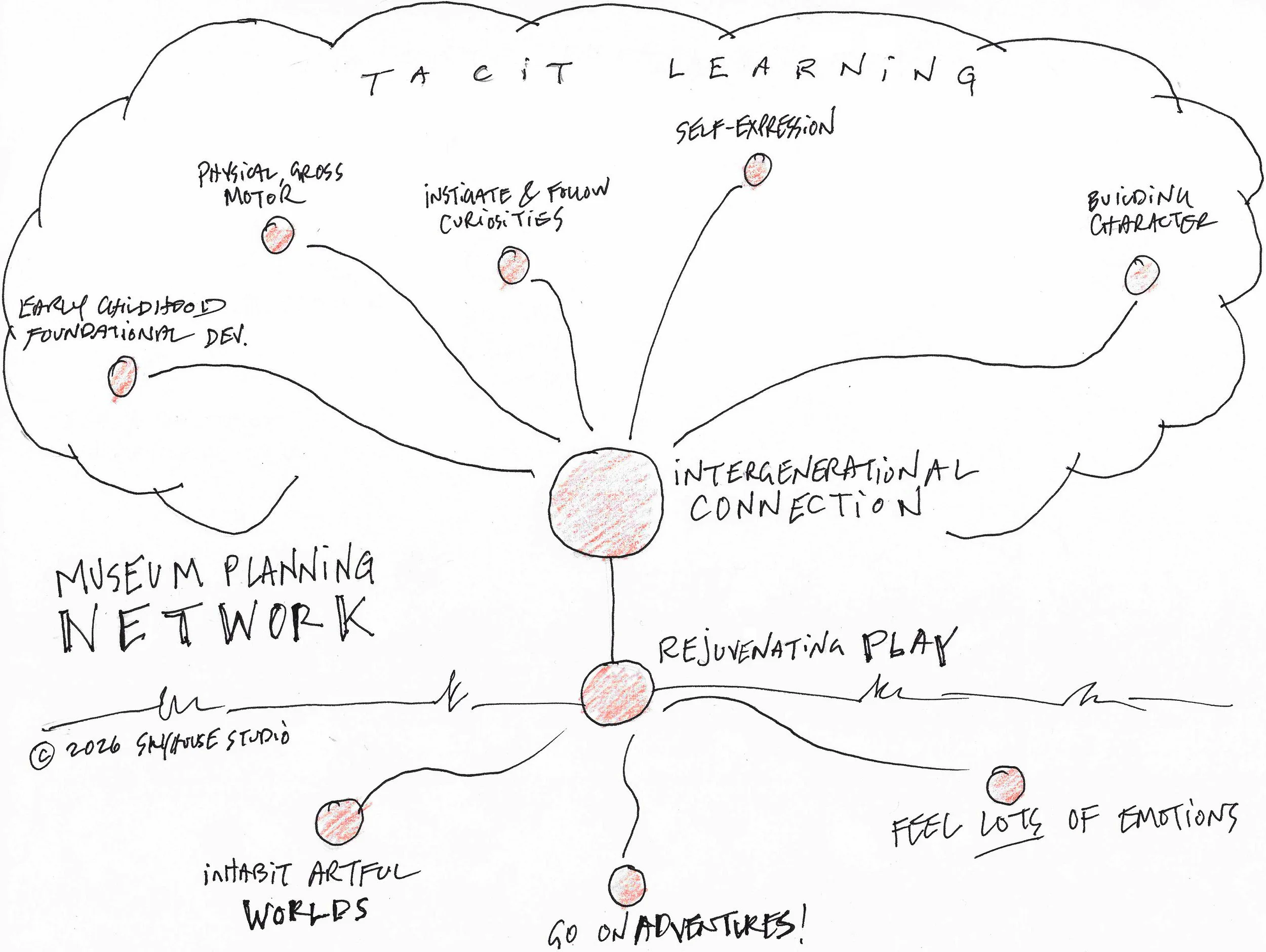
2. Expanding What You Audit
Good museums frequently conduct audits measuring everything from annual school field trips to exhibit downtime. Quantitative performance indicators can be useful (especially to satiate inquisitive board members), but you may be measuring the wrong things.
A museum could have strong attendance, high satisfaction scores, and impressive exhibit utilization while still offering an experience in which adults spend most of their time supervising, correcting, waiting, or looking at their phones.
Even well-intentioned surveys can bias results or produce unhelpful answers by asking guests to validate rather than evaluate (most guests struggle to evaluate). For example: Did you have a good time at the museum today?
What behaviors indicate genuine, shared engagement? How do visitors transition between moments of connection and frustration? How does the physical environment encourage or discourage adult participation? How do staff interactions shape the emotional atmosphere?
Qualitative questions of feel are often under-considered because feelings resist objective measurement, but should be at the center of every new exhibit, amenity, and long-term plan.
3. Refocusing Your Funding Options
When discussing intergenerational connection, a common reaction is: “That sounds fine, but we have to quantify the museum’s educational impact to continue receiving funding.”
I am not indifferent to the stresses of donor cultivation and grant reporting. If a museum declares itself a place of learning and receives funding from organizations with educational mandates, it stands to reason that it must substantiate those claims.
But does the funding conversation change when the mission evolves? For example: If a museum prioritizes robust play invitations for physical, heart-thumping exercise, it might seek support from hospitals, healthcare foundations, and sports organizations rather than being limited to school-readiness and STEM- minded foundations.
If a museum prioritizes intergenerational connection through rejuvenating play, the focus shifts again. Promising donors may recognize play as a lifelong human need rather than an activity reserved for early childhood education alone.
Unexplored partnerships become more strategically relevant when the museum focuses its understanding of whom it serves. If the children’s museum becomes a place where children, parents, grandparents, caregivers, and community members rediscover curiosity, creativity, connection, and joy together, new potential funder categories could include Holistic Health and Well-being, Aging and Longevity, Mental and Emotional Health, Family Support, and Social and Community Connection.
This shift may not alleviate the need to substantiate impact, but it better aligns reportable outcomes with funder objectives.
Conclusion
You may read this article and think: Yes, of course we want adult caregivers engaged. Yes, our museum should foster connection. Yes, we need to be more responsive to the emotional experiences of families. What exactly is new here?!
Consider the difference between these two strategic questions:
How can we use play to help children learn?
How can we create experiences that leave children and their caregivers more connected, curious, and emotionally energized?
Both could produce learning. But they might lead to different decisions about exhibits, staffing, adult participation, and evaluating success.
In our work, we've repeatedly observed museums investing heavily in interactive exhibits for children while overlooking the subtle ways their design positions adults as spectators rather than participants. Children's museums are designed primarily around what children can do. What if they were designed around what could happen between people?
The truly interesting proposition is not that intergenerational connection matters. It's that this purpose might deserve to displace other organizational priorities. What should a museum stop or start doing? Which investments might become less important? What traditional practices should be reconsidered to benefit the organization and the community it serves?
