
Part 1 of 2
Museums could be in trouble. Slowed attendance. Reduced funding. A downward trending birthrate. Everything is more expensive and there’s increased competition for families’ limited discretionary spending. People are looking for easy-escape entertainment, as evidenced by the recent resurgence of movie theater ticket sales. How can children’s museums continue to be an exciting invitation if often seen, in contrast, as too boring, too educational, and too exclusionary for the rest of the family?
I have dedicated my career to planning and designing museums that champion the joy and wonder of childhood. Our world is better when children’s museums thrive. But I see these warning signs, so I ask: What do children’s museums say that they do, and are there other places that do it better? Another way to come at this question is: What could children’s museums do better than anywhere else? What benefit could be gained by an honest self-assessment and a tightened focus on what could set children’s museums apart?
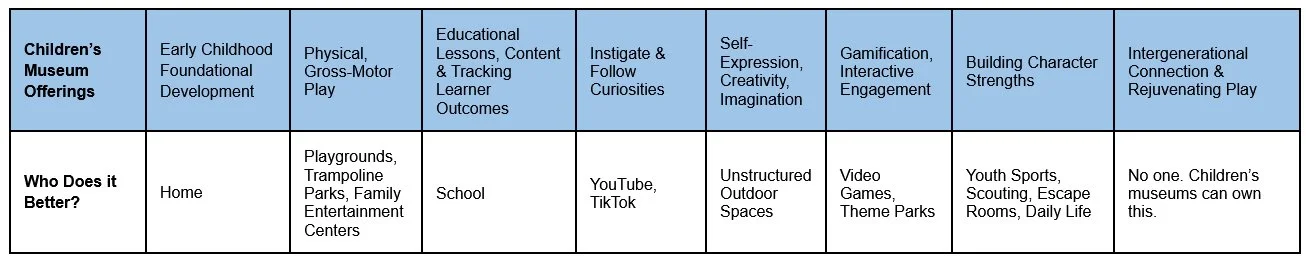
The following chart lists 8 core experience opportunities that most children’s museums aspire to provide to their guests. Below each opportunity, I suggest where this experience may be more potently available than at a children’s museum.
This is not an indictment or dismissal of these offerings. Each one admirably serves children’s museums’ missions. This article is about identifying why people may choose places to go instead of children’s museums and, ultimately, what we can do to address that gap.
To elaborate on the chart:
Learning to roll from back to tummy, feeding oneself with utensils, and exploring objects with hands and mouth are important examples of early childhood foundational development. And while these opportunities do exist at children’s museums, all of this can be more easily, more readily, and more affordably achieved at home.
When my oldest child was young, he needed tons of physical activity to self-regulate. We went to trampoline parks, even though I worked at a children’s museum. Pound-for-pound, children’s museums cannot offer the same gross motor amenities that a trampoline park can. Foam pits, bouncy castles, dodgeball courts, rope swings, laser tag, trampoline runways, climbing walls, ninja-warrior-style obstacle courses… These venues are set up for sweaty, safe, and frenetic play, easily deploying timed admission tickets, age-identifying bracelets, and liability waivers that grown-ups happily sign.
I believe people can learn when they play but this approach to learning is tacit rather than explicit. For example: Learning how to ride a bike is tacit learning. You can’t really learn how by reading instructions or being told what to do. You learn through practice and feel over time. Explicit learning is when you actively engage new content for the purpose of acquiring new information, e.g.: What is the water cycle and how does it work? Most children’s museums confuse these two types of learning and disproportionately promise content delivery and learner evaluations that would be best accomplished, explicitly, at school.
When I was a kid, I would spend hours leafing through our 22-volume World Book Encyclopedia. An initial exploration of “How we hear things?” might stumble into a magnified look at “butterfly wings” or tracing a map of the “Galapagos Islands.” Whether we like it or not, children today use YouTube and TikTok to scratch their curiosity itch. Algorithms track their searches and instantly serve up something new that might also be interesting. By comparison, museum exhibit provocations track at a much slower rate and following up on those curiosities is, at best, delayed.
My mom claims the reason I’m a creative professional is because she sent me to my room a lot as a kid. In other words, imagination, creativity, and self-expression require some alone, unstructured time to think and not perform for anyone but yourself. Conversely, museum exhibits are structured and public. Upside: Getting sent to your room is cheaper than a museum membership.
When thinking about gamified, immersive, interactive engagement, I’m on the fence. Growing up in Philly, one of my favorite museum exhibits was exploring a room-sized, interactive human heart at the Franklin Institute. Memorable. And scrambling through it thirty years later with my kids, they were unsurprisingly unimpressed. Today, everyone walks around with a super computer in their pocket. Whenever I see an exhibit that tries to gamify “Where Electricity Comes From” or “Why We Brush Our Teeth,” I cringe. Video games do gamified, interactive engagement wayyyy better.
There’s a recent interest in seeing if children’s museum exhibits can foster character building. I think an exhibit can invite and reward certain kinds of behavior, but for someone to build life-long persistence, bravery, or kindness, this happens over a much longer period of time, through thousands of conscious and subconscious interactions. A 20-minute run through a museum exhibit cannot equal this process.
When I think back to playing hooky and taking my own children to the museum or zoo for the day, my memory is filled with all the little in-between moments: Excitedly planning our adventure the night before, packing snacks, driving into the big city, having a picnic lunch while they chase pigeons, buying a little gift shop souvenir, watching them fall asleep on the way home. Even now, I still get chills thinking about these special, shared moments. This connection was possible, independent of the actual museum play experiences. Imagine what we could do if we leaned into this opportunity ALL THE WAY.
I anticipate my colleagues' initial push-back.
Some will say that children’s museums work in aggregate; we provide access to all of these opportunities. Being the best source for any one category is irrelevant. But if you’re losing guests to video games, trampoline parks, pottery studios, and free public playgrounds, you may want to reconsider this generalist approach.
Some of you may reject these 8 core experiences all together and argue more broadly for the “power of play.” Access to play is essential to children’s healthy physical, intellectual, and emotional development. “Play is the work of the child.” This is an argument the Association of Children’s Museums has been making for as long as I can remember. If you take this stance, then you’re saying there is no need to prioritize anything but play. If this message continues to resonate with your guests and funders, then who am I to argue? But I hear museum leaders beginning to worry.
I wholeheartedly believe in the power of play, but as an industry, maybe we’re unclear how that power can be directed to be more valued by children, caregivers, museum staff, and funders. If a child can play in a puddle with sticks and a pine cone, what’s so special about play that it requires a multi-million dollar, operationally-heavy institution to house it? We all should have an answer to this question.
Where We Can Go From Here
I think children’s museums are perfectly poised to be the place where we all go, regardless of age, for connection through play. But this won’t happen without first realizing and embracing that this is our opportunity. For a children’s museum, the “power of play” isn’t to educate. The power of play is to connect us to each other. A museum designed for connection is very different from an institute designed for educating.
In my next article, I will offer what I think the far-ranging implications are for children’s museums going all-in on intergenerational connection and rejuvenating play.
