Children’s Museum vs Trampoline Park
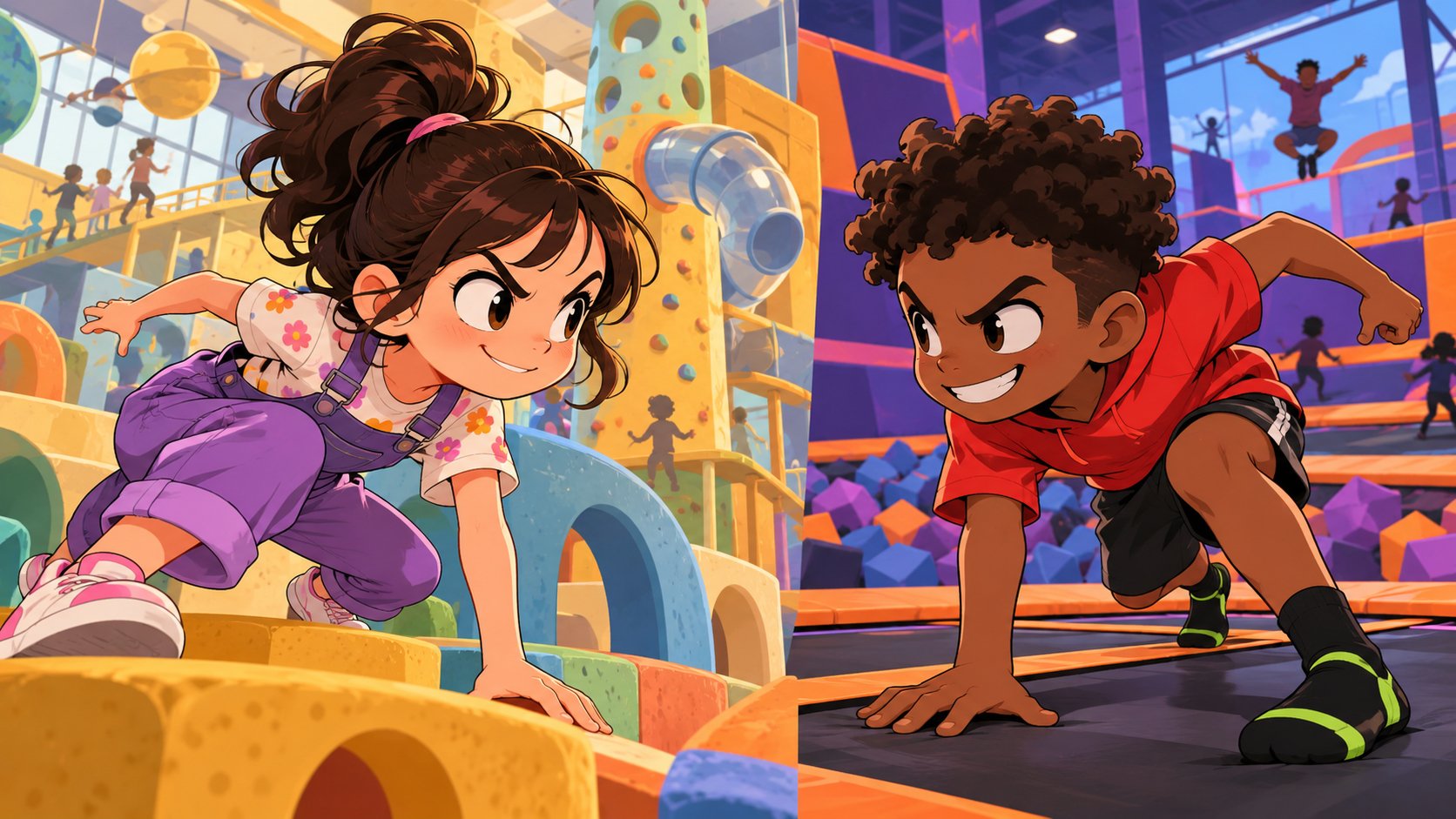
Family entertainment centers and trampoline parks, more specifically, offer high-energy physical play that, on the surface, resembles physical play at a children’s museum. As museums try to sharpen their distinctive value proposition, the trampoline park presents an interesting dilemma. Within their shared territory of physical play, what differentiates children’s museums from trampoline parks? And importantly, do children’s museums hold any advantage?
This article clarifies the differences and argues that children’s museums do have unique territory to claim. But museum leaders might need to rethink their approach to physical play in order to claim it.
Physical Play Is More Than “Blowing Off Steam”
Physical play is not just exercise. It is a path to embodied self-knowledge. Through physical play, children develop authentic body trust: the felt confidence that their bodies are intelligible, capable, and safe to inhabit.
Children build body trust by gradually discovering, through calibrated physical exertion, what their bodies can do. They learn to interpret bodily sensations not as mysteries or threats, but as useful information: This is what tired feels like. This is what nervous feels like. This is what strong effort feels like. This is what balance feels like. This is what recovery feels like. Over time, the child’s body stops feeling like an object to manage and starts feeling like an integral part of the self.
In our increasingly sedentary, screen-based lives, children are losing opportunities to develop this kind of bodily knowledge. A 2025 review of 24 studies of screen exposure among children ages 0–7 found significant negative associations between sedentary screen time and motor development in seventeen of the studies. Poorer motor competence can, in turn, contribute to lower perceived physical competence, creating a cycle in which children feel less capable, participate less, and gain fewer opportunities to develop body trust.
With the concept of body trust in mind, we can more clearly distinguish the physical play offered by trampoline parks and children’s museums.
What Trampoline Parks Do Well
It would be a mistake to dismiss trampoline parks as mere entertainment. In some cases, they might even cultivate body trust better than some children’s museums.
A trampoline park gives children an unusually intense experience of vigorous action. Children encounter height, speed, momentum, balance, disequilibrium, exertion, and manageable fear. Those are exactly the kinds of experiences that can contribute to body trust.
And they arise through the central activity of bouncing. The feedback loop between intention and sensation is immediate: I push harder; I go higher. I move my arms this way; my body rotates. I land badly; I adjust. I am scared of that height; after ten attempts I am less scared. Through bouncing, the body becomes understandable in several important ways.
What Children’s Museums Do Better
The trampoline park provides a very intense but relatively narrow band of embodied experience. Modern trampoline parks expand this vocabulary with climbing walls, obstacle courses, foam pits, and dodgeball, but the environment remains largely organized around high-arousal gross-motor activity.
A good children’s museum can offer a much broader physical vocabulary. That difference matters if body trust means not simply, I am comfortable exerting myself, but, I understand the extraordinary range of this complicated physical instrument that is me.
Being able to bounce high is not enough to prepare young adults for the complex physical projects of everyday life: maneuvering a sofa into an apartment, pushing a wheelbarrow of gravel through a garden, fixing a fence, or paddling a kayak. Such tasks require a different constellation of body knowledge: force modulation, grip, spatial judgment, cooperative movement, pacing, awkward postures, and nuanced endurance.
Museums can offer more finely calibrated gradients of physical challenge. One child climbs three feet. Another climbs eight. One crosses the wide bridge. Another tries the rope. One slides down the sand dune. Another runs down it. The child continually asks, often unconsciously: How much challenge am I ready for? This process of self-calibration might be one of the most important ways body trust develops.
Trampoline parks provide calibration too. Children decide how high to jump or which obstacle to attempt, but trampoline physics can introduce forces that exceed a child’s ability to judge and control them. The physical forces involved in bouncing are inherently intense, making them harder to modulate gradually.
Finally, caregiver engagement might be the most important difference between the trampoline park and the museum. At a trampoline park, the parent frequently becomes a spectator or safety monitor: Don’t do that. Watch out. Stay where I can see you. Five more minutes.
A well-designed children’s museum, in contrast, can help parents and caregivers see and support their child’s developing ability to interpret body signals. By observing and verbalizing what is happening, caregivers translate bodily experience back to the child: You were nervous, and you tried it. You’re breathing hard because your body is working. You found your balance. You rested and came back. These small acts of narration teach the child that bodily sensation is understandable and manageable.
Conclusion
With regard to physical play, the fundamental distinction between trampoline parks and children’s museums is this: trampoline parks offer high-intensity, relatively narrow-spectrum physical play. Children’s museums can offer variable-intensity, broad-spectrum physical play. That might sound like splitting hairs, but in the development of body trust, the distinction matters.
Body trust requires something trampoline parks are less able to provide: a broad range of physical experiences that stretch children’s opportunity to encounter many different body states—from sweaty exhilaration to careful concentration, from intricate dexterity to restorative calm.
By experiencing the transitions between these states, the body becomes more legible. The child discovers not simply, My body can go! but, I can discover the astonishing range of things my body can do. The second proposition is more sophisticated, and it helps explain the common intuition that trampoline parks, for all their energy and appeal, are missing something.
But the museum only earns the right to claim this advantage if it stops treating physical play as the unserious material placed between the “educational” exhibits. Families have found another institution willing to offer children joyful, unapologetically physical play. If children’s museums believe they offer something developmentally richer, they need to articulate exactly what that additional value is—and design exhibits that manifest it decisively and memorably.