
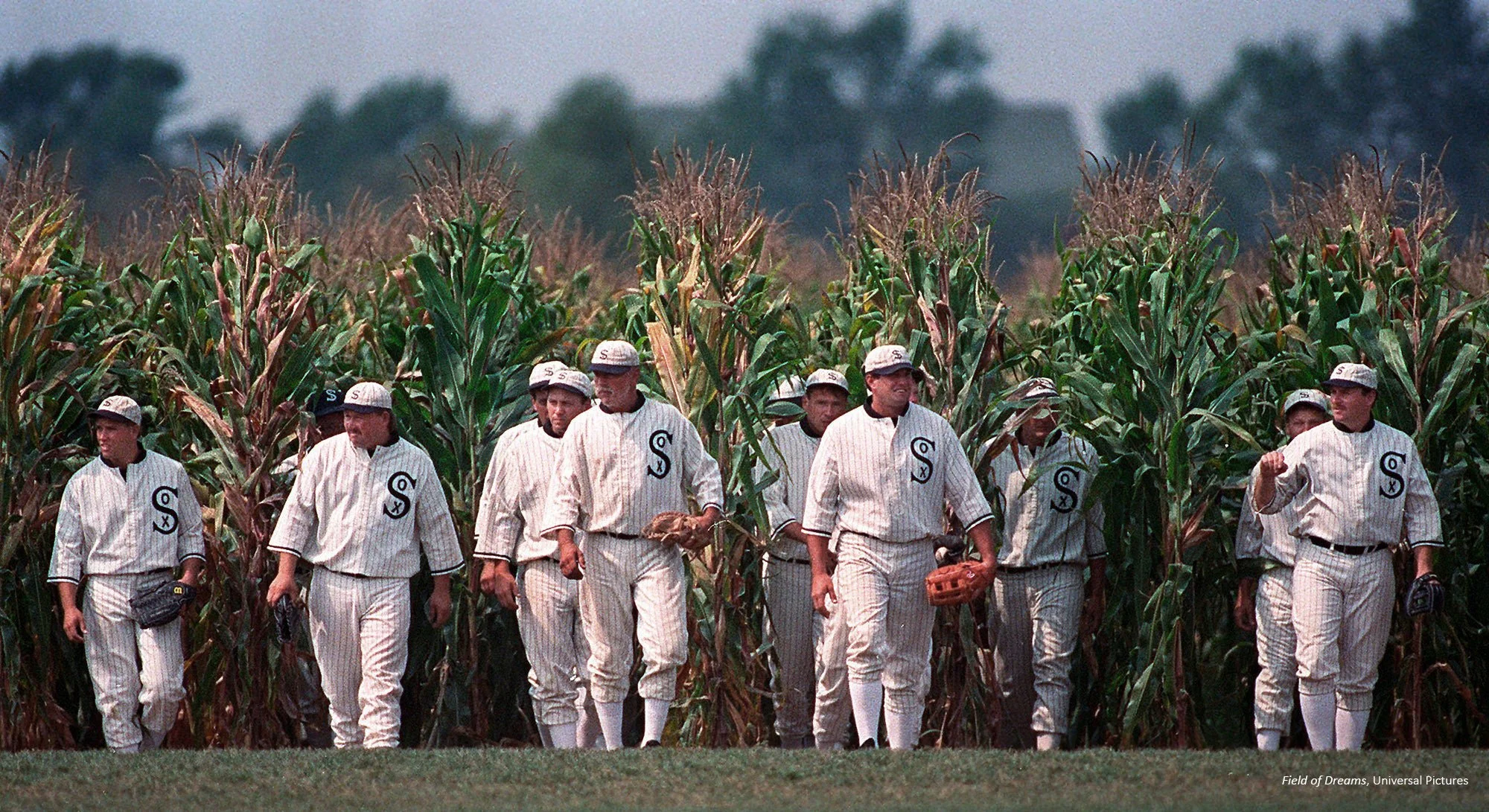
“If you build it, [they] will come.”*
But how big should you build it?
Whether you’re undertaking new museum construction, an expansion to an existing facility, or building a ballpark for ghosts*, you’ll no doubt have many opinions coming your way. Rather than immediately deferring to expensive consultants, what if you could prepare yourself to lead these planning conversations with historic data, rule-of-thumb metrics, and good ol’ intuition?
Let’s look at an example drawn from real world scenarios.
The Children’s Museum of Fredonia serves approximately 200,000 guests annually, growing 3% incrementally over the last 3 years. They have 10,500 square feet of interior exhibits in a 33,000 square foot facility. They share 135 parking spots with a neighboring business. Guests and staff feel crowded, parking is always tight in the mornings, and museum leadership is considering an expansion. How big an expansion should they consider?
Many organizations answer this question by first asking: How much money can we raise? This approach suggests that building as big as the budget will allow is the best approach. But will this new building be operationally sustainable? Will you be able to balance your budget 3 years after you’ve opened your project?
The first questions I would ask are:
What is a reasonable expectation for this museum’s future attendance if the museum were bigger? 250,000? 350,000 annual guests? What are the attendance numbers at other cultural institutions in Fredonia? What are the attendance numbers at other children’s museums in metro areas similar in size to Fredonia? (Children’s museums publish their annual attendance online.) What are the demographic trends in Fredonia over the next 30 years? Increasing? Decreasing? Aging? Holding steady? (Demographic forecasts are also readily available online through federal and state databases.)
Something very important to keep in mind when forecasting attendance is that your first year after opening or expanding your museum will not likely be your “normal” year and should not be used for your baseline predictions. Year 1 excitement spikes attendance. Year 2 will see a dip or a "sophomore slump.” We look at Year 3 as the stabilization year. This third year could realistically see a 15-20% drop from Year 1 opening attendance.
After Year 3, it could be safe to assume a steady 3% increase in yearly attendance until 2 things happen: First; your museum’s exhibits begin to show age and feel dated after 7-8 years (the shine begins to wear off). And second; your museum begins to feel crowded again. To predict when this could happen, take the number of total guests served per year and divide by the total area of interior exhibit space. For children’s museums, if this number is between 13-18, you’re optimized. If this number is greater than 18, you’re probably feeling crowded. If this number is less than 13, your building may be too big or under-performing.
Returning to our Fredonia example, they’ve determined that their Year 3 stabilized attendance can reasonably be set at 275,000 guests served per year. They want to size their museum expansion to serve approximately 15 guests per square foot of interior exhibit space.
275,000 guests / 15 guests per exhibit square foot = 18,333 square feet of interior exhibit space.
If the museum already had 10,500 square feet, they would be looking to add roughly 8000 square feet of exhibits.
The increased guest attendance and expanded exhibits will also need to be supported by possibly increasing space for bathrooms, storage, staff offices, classrooms, guest amenities, accessibility enhancements, parking, etc… Here are arguable rules of thumb for children’s museum planning: At least 40% of your museum’s interior space should be allocated for interior exhibits. 60% covers everything else. (We also use rule-of-thumb percentages for guest amenities, administrative, operations, and circulation spaces too).
If the newly renovated Children’s Museum of Fredonia will have 18,500 square feet of exhibit space to comfortably serve 275,000 guests annually, then the total museum should be upsized accordingly to 46,250 square feet (18,500 / .40). With this total, you can appropriately right-size not only your building space but staffing sizes and yearly operational budgets, all based on your multi-year attendance forecasts, not by how much you’re able to raise and spend in a capital campaign!
What about parking?
Here’s a down-and-dirty set of equations. Take your anticipated annual attendance and divide it by the number of days you’re open per year. This will give you the average number of guests per day you need to serve:
275,000 guests / 300 operating days = 917 guests per day
Next, approximate how many guests per year visit your museum through means other than personal vehicle, e.g.: bus, rail, bike, rollerskates, ride share. Let’s say it’s 10%.
917 x .10 = 92 guests per day don’t require a parking spot
917 - 92 = 825 guests need a parking spot
If your museum is like most children’s museums, you see roughly 70% of your daily guests from 10am to 1pm.
825 x .7 = 578 guests served over 3 hour period = 193 guests / hour
Peak daily attendance is achieved in the mornings when average dwell time is 2 hours.
193 guests/hour x 2 hours = 386 guests
Convert this number to vehicles by dividing 386 by the average number of people per car:
386 guests / 2.5 guests per car = 154 vehicles
Add staff parking needs (let’s say 40 spots for this example) and a 10% buffer:
154 guest spots + 40 staff spots + 10% buffer = 180 parking spots
In this example, the museum was sharing 135 parking spots with a neighboring business, but the expanded museum will need approximately 180 spots. What now? Either more space for parking will need to be found or the guests you serve need to be distributed over more days of the year. Maybe everyone coming to your museum will ride their bike or be teleported, like on an episode of Star Trek. In any case, you now have the numbers and formulas to make decisions and right-size your parking needs.
If you’re still reading this blog post, congratulations and thank you. There are architects and museum planning experts who may bring different formulas and perspectives to this conversation, but I think it’s important for museum leaders to be informed, proactive question-askers. All too often, we see fundamental project parameters set by people who won’t be standing with you 5 years after your project opens. You are your best advocate and resource. If you build it, they will come… and you’ll be ready!
